Tree Pruning vs. Tree Trimming: What Your Trees Really Need
Pruning Vs. Trimming
After over a decade of experience and conversations, I am frequently asked about what the difference between pruning and trimming is. I use both words specifically when I speak about the cutting service that I recommend for a particular tree, shrub or bush. It can seem the words are interchangeable due to the process being exactly the same. But the difference in them are the beginning of understanding how to best maintain your larger woody plants.
A simple way we at Morvin Tree Pruning like to put it is “trimming is for people and targets, pruning is for the tree”. When looking at a tree and determining needs it is important to remember that trees are not very thrilled about living around people. We compact the soil, do not consider PH, we remove the leaves which act as an organic layer, and when the tree does thrive in the environment it’s in we say it is growing to fast or big. Morvin Tree Pruning is happy to offer options that consider the goals of the customer, the given space and the trees overall success. If your unsure, about which goals to consider please see our C.A.S.H pruning page.
Tree Pruning
The name Morvin Tree Pruning was selected is due to the much more scientific based understanding of why trees need pruning. When discussing tree pruning Morvin Tree Pruning considers a tree’s natural habitat in the forest. The forest interior will have many trees, all typically exhibiting one main stem and growth at the very top of the crown forming almost a singular canopy with the rest. This form is due to the lack of sunlight accessing all other parts of the tree which initiates buds to grow along the trunk. Trees in the urban forest will have potentially 360 degrees of sunlight for its entire life. This prompts the tree to grow more branches, which act autonomously. They create what they need for themselves passing only a little back to the rest of the tree. Why is this? Trees with such abundance of light assume they are the trees on the edge of a forest. They grow as much and as thick as possible to protect the interior of the forest from wind events. They act as a barrier for protection to keep the ecosystem alive.
The collective efforts of trees in a forrest setting is continuing to be understood. But this simple understanding to why the trees grow the way they do delivers important information for why pruning is necessary. Left unchecked tree limbs will continue to grow towards the sun. They will create lateral branches, typically half to one third the diameter of the dominant stem knowing that if they break in a storm or even under their own weight, there is another branch ready to assume the apical role. Where arborists come in is when the forces acted on the tree by gravity, wind or a defect could potentially cause a failure. By preemptively reducing this end weight we mimic the natural shedding of live branches but on our own terms and in a safe manner. Potentially saving a larger break closer to the trunk that the tree will have a harder time healing from.
Morvin Tree Pruning prides itself on proper live growth pruning over all its other competencies. Continuously, “sucker thinning” is being sold as correct pruning by cutting the little branches in the middle off. But during a storm, you don’t see all the little branches in the middle fall out, you see the branches at the end fall off. This is where pruning should be performed. Arbitrarily removing “suckers” which are actually called watersprouts, does not change any of the leverage dynamics created by the tree. It just creates wounds on the main trunk that restricts water and nutrient transport. It also limits the trunk from developing taper which adds significantly to the trees strength. This incorrect cutting is repeated due to the ease of accessing them, the benefit of less debris but in most cases a seemingly large visual difference can be created. Tree pruning is about making less cuts in harder to reach places.
Morvin Tree Pruning’s proposals provide the location of the tree on your property, the size and species, the goals/objectives, the amount/size of cuts, as well as locations in the tree for cutting to take place. It is paramount this be established before work is to be performed to limit damage by untrained cutters.
Tree Trimming
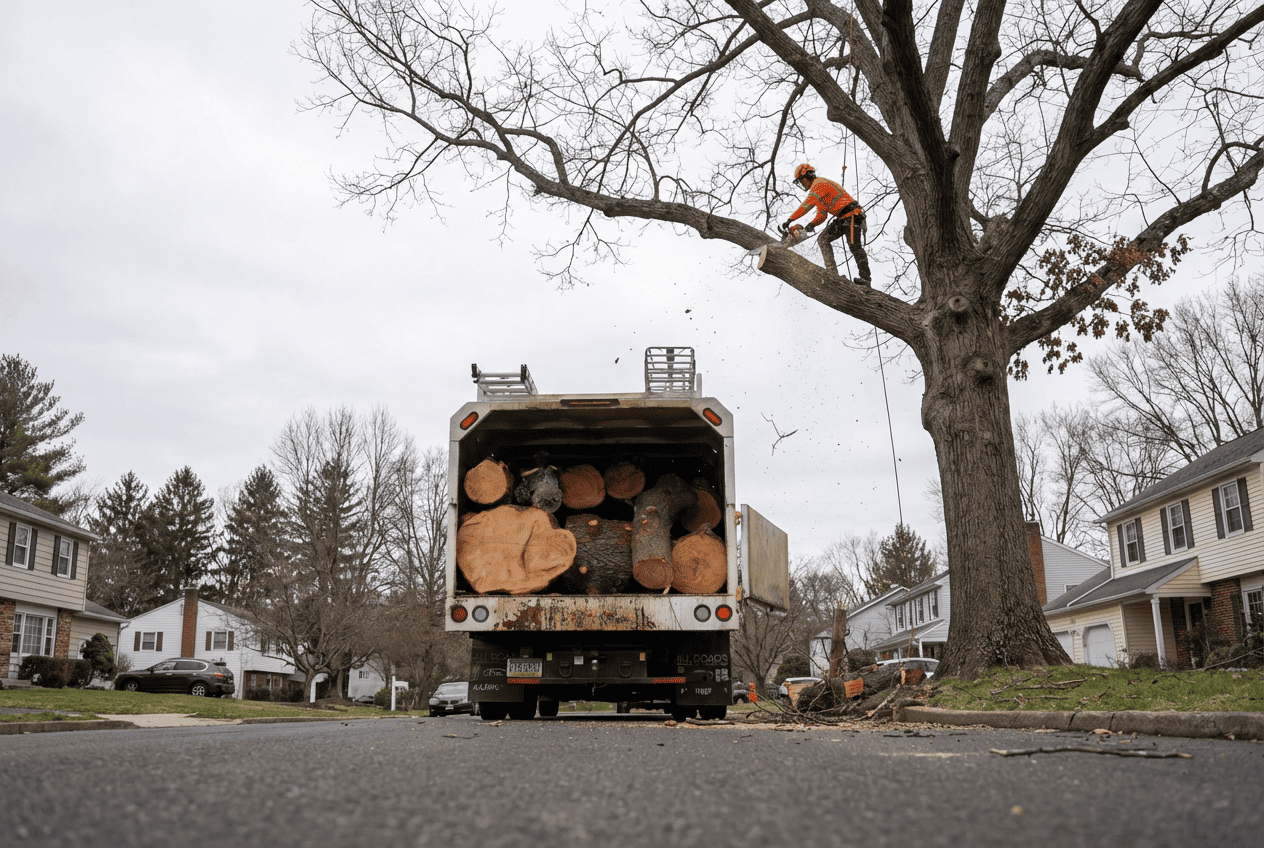
The term tree trimming is typically used to describe cuts that are made to a predetermined point or for a desirable look. Cutting away from power lines, providing clearance for a house, getting separation from a walkway, shaping landscape vegetation ensuring vehicle and foot traffic can pass unaffected are all objectives of trimming. Its need is crucial to keep trees from getting too close to infrastructure that could create a nuisance, expedited wear or even a dangerous situation.
When talking about tree trimming, containment is a goal/objective that is being desired. We want the tree to stay compatible with its given space so that its size does not get out of control. Topping trees, a process of reducing all tree parts to a predetermine specification is a frowned upon recommendation that still falls into the trimming category. It’s objective requirements do not follow the natural way trees prefer to be cut. It removes all the ends of the branches where the plant growth regulator auxin is developed. This hormone is vital to the trees internal processes including root growth. When topped, immediate failure mitigation is accomplished making the structure itself safer in the short term. But the tree's natural reaction to this is grow as rapidly as possible. It wants more leaves for photosynthesis in an effort to create energy to sustain itself. Left unchecked, trees previously topped will form weakly attached branches where the heading cuts were made. Morvin Tree Pruning is capable of giving recommendations to achieve these goals in a way that serves you and the tree best.