Tree Pruning/Trimming in Doylestown, PA
Health & Safety
Morvin Tree Pruning believes strongly in the science based necessity of pruning to promote tree health and safety. Health and safety pruning can typically be accomplished by the same cut and are classified into two categories; live growth and deadwood pruning. Correct removal of these tree parts can significantly boost the trees biological needs while correcting structure imbalances. An understanding of how trees grow differently in an urban setting in comparison to its natural environment is paramount when writing goal oriented prescriptions. We know that trees growing with 360 degrees of sunlight will produce many more horizontal branches in comparison to a forest setting. These branches are autonomous, making enough food to sustain themselves and compete for the sunlight by trying to outgrow the others. In this unnatural setting it is common for branches to grow too long and overextended. These branches often cause over crowding and can block sunlight from entering the canopy causing less competitive tree parts to need to be shed. It is important to note that dead wood is not always a summary of an entire tree’s health.
Dead Wood Pruning for Health and Safety
Morvin Tree Pruning is composed of experts in identifying dead, dying, diseased detached and or disfigured branches. The removal of these branches can deter adverse health affects by eliminating a host for disease, bacteria and fungus to fester. When dead branches are left in the canopy, the tree tries to grow around the branch to eliminate the entry point for pathogens. By making a proper collar cut, just outside the branch bark ridge we can promote the tree’s ability to allocate resources to other necessary functions such as growth, defense, reproduction , storage and maintenance. Not only can this service promote tree health but it is an extremely important procedure that keeps people and property safe down below. These compromised tree parts are weakly attached and can be knocked loose during weather events. They can also be a nuisance in terms of constant clean up if they aren’t dealt with all at one time. There are times when dead sections of tree can be a sign that the tree is in a state of decline due to a problem with the root system. When larger sections of the tree equaling up to and over 25% start to decline locally and originate at the tips, it is important for a thorough health and safety assessment to be done. Many times, trees can have the hazardous parts removed to mitigate risk and promote structural integrity. Morvin Tree Pruning is composed of experts who can diagnosis these conditions at the highest industry standard.
Live Growth Pruning for Health and Safety
Morvin Tree Pruning boasts its extreme emphasis on proper live growth pruning of trees. When making the decision to eliminate live tissue in an effort to promote health and safety extreme caution should be taken. Improper placement of these cuts can have severe consequences to the internal biology of a tree. If cuts are made incorrectly and without a goal oriented approach not only is nothing accomplished but your tree can have adverse effects.
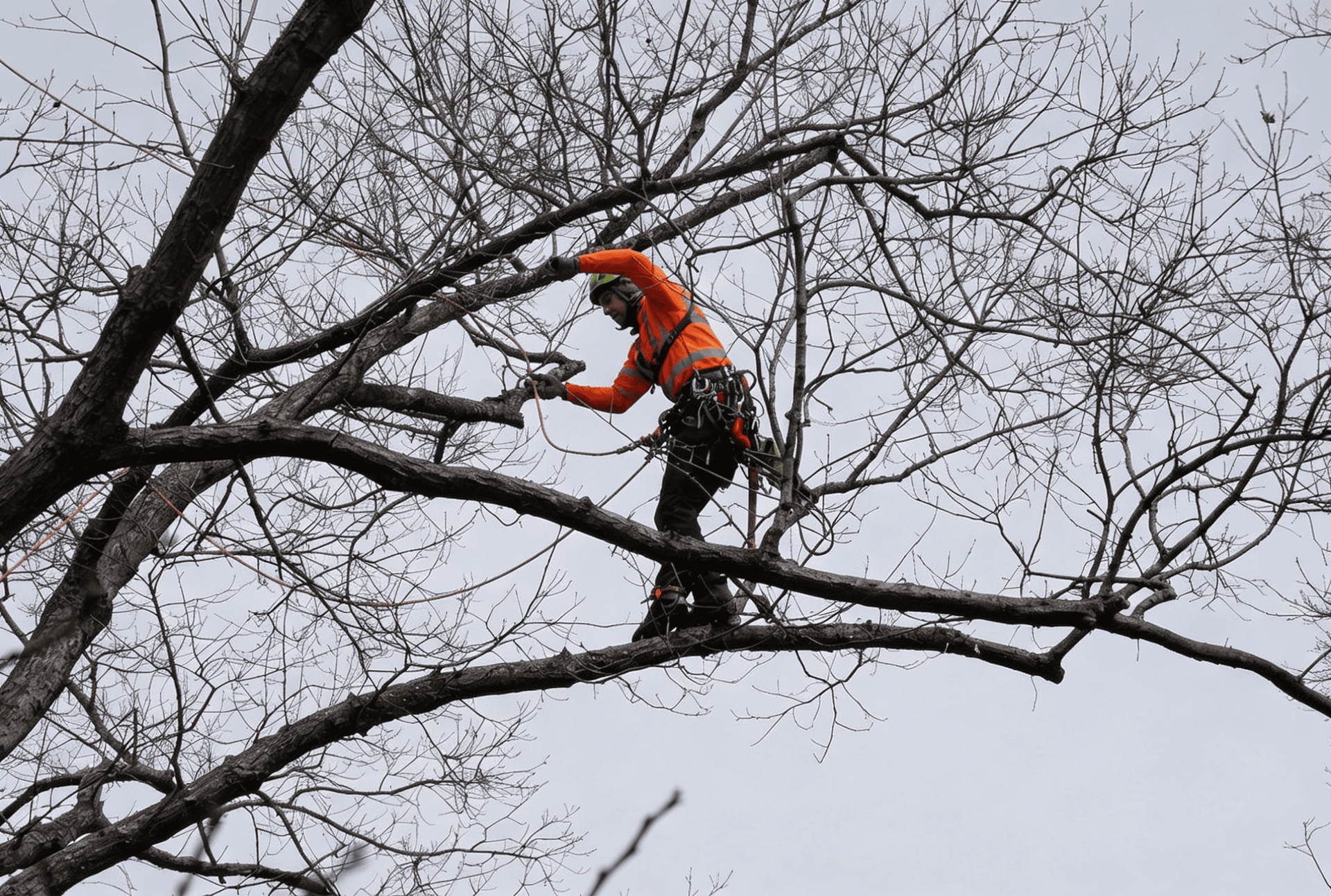
Each time a live growth pruning cut is made for health and safety it has the efficiency of being able to accomplish two goals. First, is allowing air and sunlight to penetrate the canopy reducing the chance for a humid microclimate to be created where disease agents can thrive. Second and typically the most important is failure mitigation. Failure mitigation of trees is a service able only to be provided by the most educated/skilled of arborists. Being able to traverse canopies while making proper cuts is truly combining the art and science of our craft.
Placement as well as execution of these cuts is consistently done incorrectly in our industry. Recommended topping, flush cuts and over thinning of the interior poses a serious risk to tree success. Morvin Tree Pruning provides detailed proposals of what goals are to be accomplished with the pruning; where the pruning is to occur, what percentage of live growth foliage will be removed, as well as diameters of cuts. We follow all Ansi A 300 Pruning Standards which are regularly reviewed at company meetings and tailgates.
Aesthetics
Morvin Tree Pruning understands the visual qualities trees, shrubs, bushes and other vegetation can have. Their majestic nature, colorful leaves, complex branch structures, beautiful flowers and unique shapes make them center pieces on properties. Aesthetic pruning can be determined by a number of factors which are important to weigh when choosing a plan for visual influence. Timing, species, climate, and size can all play a role in the this pruning application’s success. It is common in aesthetic pruning for cuts to be made to pre-determined positions by the use of heading cuts. A much more acceptable practice on shrubs, bushes, and even some smaller ornamental trees but can prove counter productive as cut diameters increase.
When it comes to larger tree species that are requested to have their crowns heavily reduced, not only for safety concerns but aesthetics, Morvin Tree Pruning suggests a lateral reduction. This procedure is the strategic cutting of primary stems back to secondary limbs that are able to take over the dominant role as the apical meristem. When a tree is cut back to a predetermined crown and all the leads of branches are headed back, the plant growth regulator auxin which is vital for shoot and root production is eliminated. By cutting back to proper laterals, no less than 1/3rd the size of the parent stem, you not only keep this vital hormone but keep a more natural look of the tree. Morvin Tree Pruning is consisted of Certified Arborists who are able to determine the viability of this pruning. If requested to continue the process of cutting the crown back to a predetermined size, Morvin Tree Pruning will in no way be able to promise the health, structural integrity and longevity of the tree going into the future.
Bushes, Shrubs and Landscape trees are typically better candidates for aesthetic pruning when a specific shape is desired. Columnar, pyramidal, oval, umbrella and even spiral cutting of trees has continued to determine curb appeal when valuing homes. Morvin Tree Pruning uses an array of techniques and tools to accomplish these master pieces. We write up very specific proposals that emphasize exactly the proportions you desire while aiding in what is exactly possible. We highly recommend your availability the day the work is to be done in an effort to capture your exact vision.
Structure Pruning
Structure Pruning is the number one way to correct tree growth at a young to juvenile age when the leaf to wood ratio is favorable and cut diameters will remain smaller. This systematic approach uses biomechanics to ensure a favorable form is established that will better enable the tree to withstand external loads such as gravity and adverse weather events. If this process is properly completed in a four to five part series within the first 25 years of the tree’s installation there will be little need for correction in the later years when the tree is fully matured. Not only is it the most optimal time for this pruning but it is the most cost effective. Since the tree is smaller and more easily accessed less resources are necessary to perform the work. As the tree grows and cut diameters increase, it is much more complex for the arborists to perform the work.
To properly structure prune a tree the first, most important decision is to establish a central leader. On excurrent trees such as Pines, Spruce, Hemlock and Fir it is easier to determine this. But on more decurrent trees such as Oak, Maple, Chestnut, Walnut and Gum this can be a great challenge due to the greater number of leaders occupying similar territory. In every tree one stem always sticks out the farthest. Ideally this is the chosen central leader but when existing next to infrastructure such as power lines, homes, buildings or even other vegetation its subordination may be necessary. Morvin Tree Pruning trains its Arborists consistently on proper establishment of central leaders
Next, is the arranging of scaffolding branches. These branches typically grow more horizontally. They are smaller in diameter and originate off of larger trunks. Many times they can be clustered unevenly. When these branches are ideally distributed there is much less of a chance for crossover and or rubbing branches to cause problems for main stems. When determining which of these branches should be eliminated it is prudent at times to leave “temporary” branches in an effort to not reduce too much of the live growth foliage on the interior of the canopy. These smaller, less desirable branches will still produce mature leaves that can produce much need carbohydrates to stems while adding to the development of trunk taper.
Last, we choose which will be the lowest permanent branch on the tree. Although trees would prefer these lower branches it is vital for the function of the landscape to not have these low hanging tree parts become a hazard. Foot traffic, car parking, roads, play areas, signs, lights, lawn mowing and sidewalks all should be considered when choosing this height. Typically, seven feet is desirable over yards and fourteen feet is desired over streets.
Containment
The sprawling nature of trees makes it important to keep them in check as they encroach on infrastructure. Houses, power lines, buildings, street lights, parking lots, play grounds and other assets can be cluttered or damaged when tree parts are left unchecked. The majority of clearance issues are the result of improper plant selection. Although you can’t change the growth pattern and rates of the tree in question, a number of techniques can be used to train the tree to grow in a manner that is more ideal.
Morvin Tree Pruning finds directional pruning to be the best solution when looking to clear tree branches, stems, leads and limbs away from specific targets. Directional pruning is the training of tree parts from an area where they are undesired into a space that allows them to thrive. By cutting limbs back to sustainable lateral limbs it is possible to keep a tree as an asset. These lateral cuts are ideally made as early as possible in the trees life when the leaf to wood ratios are ideal and cut diameters are small. After a few cycles of this pruning the tree will be trained to fit in the area it was planted much more efficiently.
At times entire branch removals are necessary to achieve desired clearances. When power lines, construction, safety or damage is a driving factor it is sometimes best to make the cut back at the point of origin. There are many ordinances for minimum distances trees should be away from certain infrastructure. Standard street clearance is approximately fourteen feet, while over lawn areas is seven. This may seem high in some cases but if there is going to be equipment or other traffic in close proximity to the tree it is better for proper cuts to be made while an Arborist is on site. Otherwise, there is the possibility of external forces striking the tree parts causing more damage than if it was cut to a compromised specification.
Preservation
Preservation is a word used often in our industry. Every time someone does any work on a tree they seem to think that it is considered preservation. Morvin Tree Pruning defines preservation as “the servicing of a tree when it is in an irreversible state of decline where it fails to produce any new growth and has shown sign of dieback and or internal decay”. It is important to note that even when a tree first shows signs of these decline factors it can still be considered structurally sound. Also, only a thin cambium layer is necessary to continue the production of leaves which continue to filter the air. When a tree has reached this point and preservation is considered applications of pruning can be put into place that may go outside the typical Ansi A 300 pruning standards. It may be necessary to cut back large leads to unfit laterals or it may be necessary to remove the entire tree canopy back to a trunk. Morvin Tree Pruning will devise a comprehensive and goal oriented plan with a realistic timeline so you may continue to enjoy the benefits of your tree. There are many reasons to preserve a tree even if it is likely declining. The benefits to ecosystems, wildlife, beneficial insects, underground soil amendments, air filtration, shade etc can continue even if the tree is not in a growing condition. Please consider this procedure before removing your entire tree. We look forward to working with you!
Give Your Trees the Expert Care They Deserve
Improve tree health, enhance safety, and elevate your property’s curb appeal with precision pruning from certified arborists.